Find a local office


The 2026 European Base Oils & Lubricants Summit
- Details
- Key Topics
- Who Will Attend?
- Agenda Committee
- Confirmed Speakers
- 2025 Edition Highlights
- Agenda
- Sponsors
- Media Partners
- Maximising Face-to-Face Networking
- Securing Base Oil Supply in a Disrupted Global Market
- How Base Oil Producers, Blenders & OEMs Can Collaborate Further to Ensure a Resilient Supply Chain
- Protecting Product Quality, Standards and Customer Trust During Market Transition
- Managing Pricing Volatility, Forecasting Risk and Customer Commitments
- Synthetic Base Oil Availability: Substitution Without Compromising Performance
- Automotive Market Roadmap: ICE Longevity, Hybrids, EVs and Future Lubricant Demand
- Emerging Growth Markets: EV Fluids, Data Centres, Energy Storage and Thermal Management
- Sustainability as an Economic Benefit: CO2 Intensity, PCF and Commercial Value
- Policy Outlook – REACH, PFAS, DPA/SDPA and the Reformulation Challenge
- Waste Management, Used Oil Recovery and Recycling Infrastructure
- Key Technical Innovations in Lubricants to Improve Energy and Cost Efficiency
- Re-Refining Developments: Scaling Circular Base Oils into Mainstream Supply
- Base Oil Producers
- Lubricant Blenders
- Additive Suppliers
- Engine & Gear Manufacturers
- Automotive Manufacturers
- Ship Owners
- Aircraft Operators
- Data Centre Operators
- Renewable Energy Companies
- Oil Recyclers
- Technology & Service Providers
- Trading & Distribution Companies
- Gareth Moody, Research and Technology Specialist, Cargill
- Mark Lord, CEO, Aztec Oils
-
Valentina Serra-Holm, Business Head – Engineered Fluid Solutions, Perstorp
-
Stefanie Deuser, Head of Product Stewardship Solutions Performance Chemicals, BASF
- Darren Middleton, Head of Category Fuels, Lubricants & Energy. Ferry, Cruise, Ro-Pax & RoRo, P&O Ferries
- Tim-Oliver Mattern, Global Market Manager Steel Industry – Senior Lubrication Expert, Carl Bechem GmbH
Conference Chairs:
- Valentina Serra Holm, Business Head – Engineered Fluid Solutions (Specialty Chemicals), Perstorp
- Damian Weinzierl, Head of New Mobility, FUCHS Group
Speakers:
- Bart Zwitser, Manager Technical Support & BDM Lubricants, TotalEnergies
- Martial Sauvee, Global Marketing Development Manager, ExxonMobil
- Guy Boucher, EMEA Marketing Manager – Data Centre and Thermal Management, Castrol
- Peter Björklund, Technical Manager Drivetrain & E-Propulsion Oils, Traton AB
- Benn Heatley, Global ESG Manager, Afton Chemical
- Peter Kaali, Head of Pricing & Product, VaroPreem
- Anders Petterson, Global Lubricant Coordinator, Volvo Construction Equipment
- Jan Wahlström, Senior Business and Strategy Lead, Neste
- Francesc Alomar, European Product Manager for Grease Additives, Lubrizol
- Mattia Adani, President, Union of European Lubricants Industry
- Tobias Platen, Global Head of New Business Development and Surfactant Research, Zschimmer & Schwartz
- Orkhan Aliyev, Head of Refinery & Petrochemical Business Management Department, State Oil Company of the Republic of Azerbaijan
- Marco Digioia, President, European Association of Lubricants Manufacturers
- Roland Van Liere, Commercial Manager, LBC Tank Terminals
- TBC, Senior Representative, Emerson
- Nikhil Agarwal, Managing Director, Globestar Energy
- Matthias Hof, Global Business Manager Biolubes Ester, Globestar Energy
- Bhupinder Singh, Director – Global Business Development, BlueChem Group
- Ksenija Topolovec Miklozic, Director, POWERTRIB EUROPE
- Boris Zhmud, Sr Lubricants Technical Advisor, Independent Consultant
Event Overview
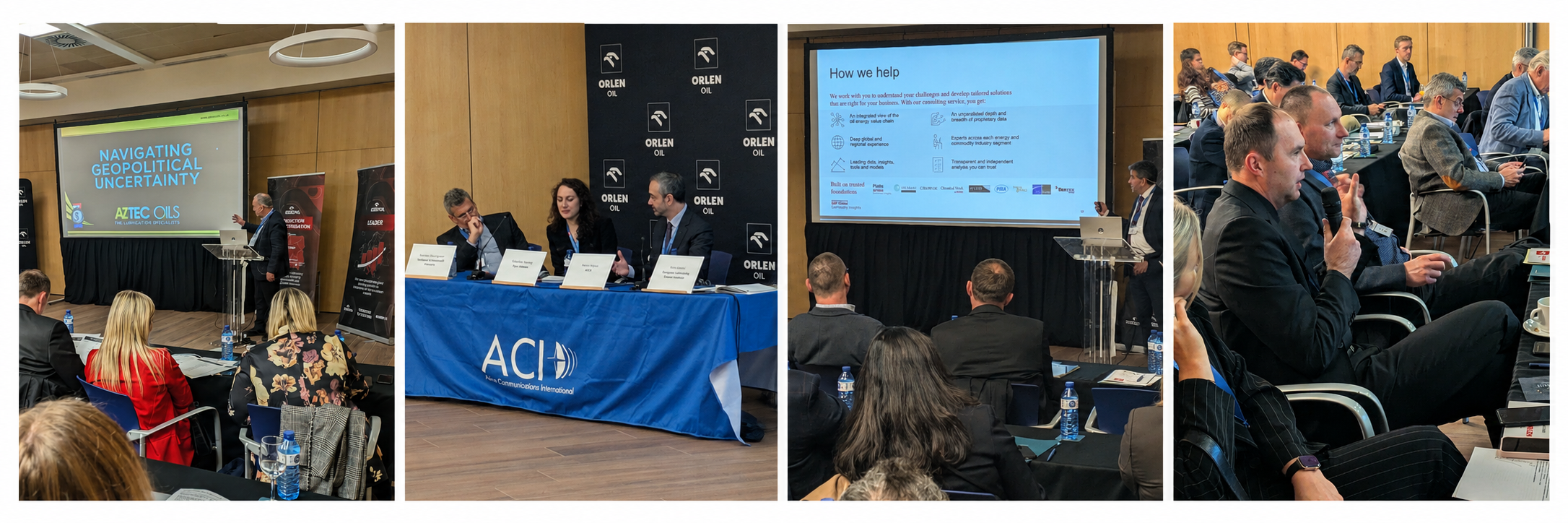
The 2025 edition of ACI’s European Base Oils & Lubricants Summit brought together base oil producers, lubricant manufacturers, re-refiners, additive and technology providers, analysts, industry associations, regulatory specialists and downstream lubricant professionals in Valencia to examine the forces reshaping the European lubricants market. Across two days of presentations and discussion, the event focused on the transformation of Europe’s base oil landscape, regulatory pressure, geopolitical uncertainty, circularity, sustainability, quality management, feedstock challenges and technical innovation across industrial lubricant applications.
Europe’s Base Oil Market Transformation
A major focus of the conference was the changing structure of Europe’s base oil market. Presentations examined how Europe’s demand profile is shifting toward higher-quality base oils, including Group II, Group III, Group III+ and selected Group V products. Speakers highlighted that while lubricant demand may remain relatively flat in volume terms, premiumisation is creating stronger demand for higher-performance base stocks used in automotive, heavy-duty, industrial and specialist applications.
The market discussion also explored the long-term outlook for finished lubricants, the strategic implications of new Group III/III+ capacity, the resilience of Group II in heavy-duty motor oils, and the growing role of re-refined base oils in the future supply mix. This positioned the European market as one undergoing structural adjustment rather than simple demand growth.
Regulation, REACH and Market Fundamentals
Regulation was addressed as both a commercial risk and a driver of innovation. The agenda included detailed discussion of EU and regional regulatory frameworks, including REACH, CLP, EUDR and ESPR, as well as the differences between EU, UK and Turkey regulatory regimes. Speakers examined how these frameworks are increasing compliance costs, documentation requirements and complexity for lubricant manufacturers.
Presentations also connected regulation directly to base oil fundamentals and pricing. Discussions covered how regional regulation and policy could affect base oil demand, finished lubricant supply, spot pricing and the wider supply-demand balance. Rather than treating regulation as a standalone compliance issue, the event positioned it as a factor influencing formulation strategy, product availability, pricing and market access.
Sustainability, PCF and Credible Environmental Claims
Sustainability was a recurring theme throughout the summit. Presentations examined carbon footprint assessment guidelines, lifecycle assessment training, sustainability metrics and the growing role of product carbon footprint data in marketing, tenders and customer decision-making. Speakers also addressed the importance of clarifying biodegradability claims and avoiding vague or unsupported sustainability messaging.
The discussion moved beyond broad environmental ambition and focused on practical implementation. Sessions considered how sustainability can be embedded into product development, sourcing, production, disposal, recycling and end-of-life management. Speakers consistently emphasised the need for credible data, common methodologies and clear definitions if sustainability claims are to support commercial differentiation and customer trust.
Re-Refined Base Oils and Circular Value Chains
Re-refined base oils were one of the strongest themes of the 2025 programme. Sessions examined the rise of RRBOs as a sustainable solution, their growing acceptance in the market, and the remaining questions around positioning, performance and customer confidence. Presentations explored the industry landscape, demand-supply trends, value chain drivers, strategic influencers, competitive positioning and future expansion roadmaps for re-refined products.
Circularity was also discussed through a full value-chain lens. Speakers mapped the circular lifecycle of lubricants from production to use, collection, re-refining and re-use, highlighting the roles of producers, distributors, service providers, collectors and end users. Lifecycle assessment data was used to demonstrate the environmental benefits of re-refining, while broader discussion focused on how stakeholder collaboration can help circular base oils become a more established part of the lubricant supply chain.
Industrial Lubricants, Feedstock Challenges and Technical Innovation
The final part of the conference focused on industrial lubricant applications, feedstock availability and technical innovation. Presentations examined the history of base oil production, the changing profile of domestic crude supply, maintaining production and quality under variable feedstock conditions, and the role of digitalisation and batch tracking in crude oil processing.
Industrial lubricant sessions explored innovations in fluid formulations, immersion cooling fluids, greases, disposal and recycling practices, hydraulic systems and sustainable UHVI hydraulic fluids. Technical presentations highlighted the role of tribology in hydraulic motors and pumps, showing how lubricant formulation, surface optimisation and fluid selection can improve efficiency, durability and performance. Overall, these sessions positioned industrial lubricants as a field where sustainability, performance and operational reliability must be developed together rather than treated as separate priorities.
Value Chain Collaboration
A recurring message throughout the event was the need for greater value chain collaboration. Speakers highlighted that lubricant producers, marketers, distributors, OEMs, additive suppliers, base oil producers, test houses, regulators, re-refiners and end users are increasingly interdependent. The conference showed that many current challenges cannot be solved by one part of the chain alone, whether the issue is raw material volatility, regulatory compliance, customer expectations, circularity, carbon accounting, supply disruption or technical innovation.
The traditional lubricant value chain was challenged as too fragmented and too distant from the end user. Speakers argued that sustainable growth requires stronger communication, shared metrics, closer technical support, better customer insight, standardised methodologies and more coordinated planning across the full industry.
A Practical Industry Discussion
Overall, the 2025 European Base Oils & Lubricants Summit reflected an industry navigating structural change rather than short-term disruption alone. Across the programme, discussions consistently returned to the need to balance supply security, cost control, product quality, regulatory compliance, sustainability and technical performance. The event positioned the European lubricants industry as a market under pressure, but also one with clear opportunities in premium base oils, circularity, re-refining, high-performance formulations, lifecycle-based sustainability and closer value chain collaboration.

Emerson (NYSE: EMR) is a global automation leader delivering solutions for the most demanding technology challenges. Headquartered in St. Louis, Missouri, Emerson is engineering the autonomous future, enabling customers to optimize operations and accelerate innovation. For more information, visit Emerson.com.
ACI has put together a range of packages to suit your requirements. These range from branding options, to full scale partner solutions and can be tailored to meet your objectives and budgets.
If you are launching a new product or service and wish to gain visibility and brand recognition within your industry, contact us today!
For commercial opportunities, please contact:
Krisztina Szabo
Tel: +44 (0) 20 3141 0603
Email: [email protected]

Lube Magazine is published by the United Kingdom Lubricants Association (UKLA), and is the Official Journal of UEIL – the European lubricants industry organisation based in Brussels, Belgium. UKLA is the trade body representing the interests of the British lubricants industry as well as being the UK Delegation to UEIL.
Lube is a bi-monthly magazine provided free to qualified subscribers. It is distributed to readers in over 100 countries and via relevant sector Trade Events.
Lube offers the European perspective on the global lubricants industry, featuring technical and industry pieces on: Automotive and Industrial sector developments; Metalworking Fluids; Automotive and Industrial Greases; Base Oil issues; the impact of new and modified product specifications; forthcoming legislation; industry news; profiles; plus a ‘Forthcoming Events’ diary.
For further information please visit www.lube-media.com
Established in 1995, ATIEL the Technical Association of the European Lubricants Industry acts as the voice of the lubricant industry, using its members’ collective expertise to push the boundaries of engine oil innovations to the benefit of the automotive industry, consumers and the environment. Membership of ATIEL is open to manufacturers and marketers of lubricants with an official presence in Europe. Visit our website for details: www.atiel.eu
Operating since 2016, Lubricant World holds a pioneering position in the industry as the first and only publication focusing on the lubricant sector in Türkiye. Through its website and social media channels, it delivers the latest industry developments, technical articles, exclusive interviews, and product reviews to its readers. With content in both Turkish and English, Lubricant World continues to serve as the showcase and trusted news source of the lubricant industry, reaching both local and international stakeholders.

Lubricant Specialists LinkedIn’s largest lubricants and base oil professional group With over 35,000 members, Lubricant Specialists is a global community of technical experts, marketers, traders, blenders, OEMs, and senior management from the lubricants and petrochemical sectors. The group is known for its active discussions, knowledge sharing, and event collaborations across the world.  https://www.linkedin.com/groups/2668663
GOMA is the Croatian Society for Fuels and Lubricants and has been working continuously since 1964 as a not-for-profit and nongovernmental professional society.
GOMA is engaged in the promotion of professionalism and expertise in field of manufacturing and application of fuel and lubricants. Its principal activity is to encourage and develop scientific and professional thoughts and views on the technical, economic and educational practices related to the production and use of liquid and gaseous fuels and the proper application of lubricants, as well as cooperation with related companies, institutions and specialised professional organisations and universities at home and abroad.
For this purpose GOMA creates and organises international expert symposia with topics in the field of technology, development and application of fuels or lubricants and also publishes a professional magazine, Fuels & Lubricants, printed in English exclusively.
F&L Asia Ltd stands at the forefront of innovation and thought leadership in the global fuels and lubricants industry. As a premier publishing and events company, we are dedicated to fostering connections, facilitating groundbreaking discussions, and highlighting the latest advancements that drive our sector forward. With a rich legacy of curating influential content and orchestrating seminal events, F&L Asia Ltd is not just a platform but a catalyst for progress, innovation, and collaboration among industry professionals worldwide. Our commitment to excellence and our passion for knowledge dissemination make us the go-to resource for industry insights, trends, and networking opportunities.

Fecc is the voice of the Chemical Distribution Industry in Europe. With a growing membership of companies and national associations, Fecc represents around 1,600 companies of which many are small and medium sized companies (SMEs). Fecc and its members contribute to innovation and sustainability besides adding value in the supply chain, by sourcing, developing, marketing, and distributing a wide range of specialty chemicals and ingredients to over one million downstream users ranging from automotive, electronics, paint, construction to pharmaceutical, cosmetics, food and nutrition industries, each with their own specialised needs. The Chemical distribution industry in Europe employs more than 30,000 people and has an annual sales leverage of approximately €28 billion.
https://www.fecc.org/

The Energy Data is an information-centric platform focused on delivering comprehensive coverage of the energy industry online. As both a B2B and B2C resource, we are committed to keeping professionals, organizations, and consumers informed with the most relevant, timely, and accurate updates from the energy world.

ASD Media is an online media company. We provide professionals in dedicated markets with news, intelligence, and interaction opportunities. During the last five years we developed dedicated websites for events, reports, news distribution and source data, and changed the name of the ASD-Network to ASDNews to emphasize the news focus.
At the event we strive not only to bring you to the same location at the same time as your customers/suppliers/peers, we strive to ensure you meet face-to-face with each and every one of your target contacts and to provide you with the time you need to have multiple unhurried conversations with them and build a lasting business relationship:
• A pre-event informal introduction the evening before the conference
• A minimum of five hours’ networking built into the two day conference agenda
• A networking grid which enables you to make your target contacts aware you are looking for them
• The option to join either social drinks or dinner during the evening of Day One
• ACI’s on-site team will assist you in locating your hard-to-find target contacts & make face-to-face introductions
Of course, if there is anybody you are unable to meet over the two days, ACI’s event team will do their best to initiate contact after the event.