Find a local office


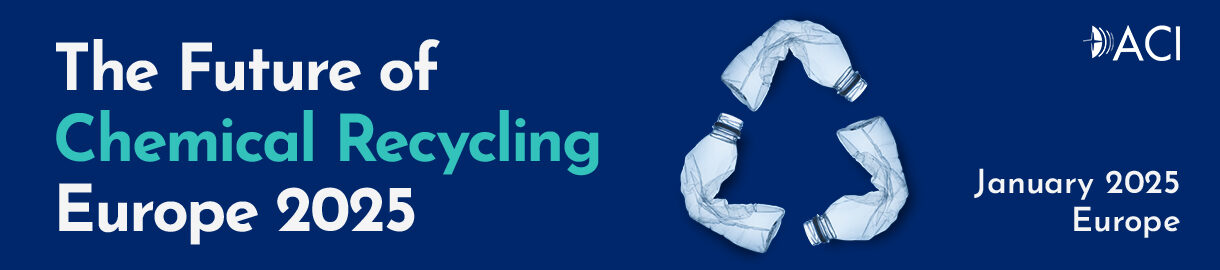
After a thought-provoking and hugely successful launch this year, ACI’s next edition of Future of Chemical Recycling will be taking place in January 2025.
ACI was proud to launch this landmark event in the realm of sustainable waste-material management in Rotterdam on the 31st January to 1st February, and brought together over 150 key stakeholders from Chemical and Energy Providers, Raw Material Suppliers, Packaging Manufacturers, Recycling Service and Technology Providers, Chemical and Sustainability Associations, Senior Chemical Consultants and Research Academics. Set against the backdrop of global concerns about plastic pollution and environmental sustainability, the conference placed innovation and sustainability at the forefront of discussions.
Join us next year to build on this foundation and help realise a sustainable Future of Chemical Recycling.
- Details
- Last Year's Key Topics
- Who Will Attend?
- Call for Papers
- Sponsors
- Agenda
- Maximising Face-To-Face Networking
- Effective Feedstock Management
- Overcoming Challenges in Energy Efficiency
- Clarification on Current and Future European Regulations
- Context of Certification for Chemically Recycled Feedstock
- Unpacking the Market Forecast and Maximising its Opportunities
- Moulding a Collaborative Industry of Recycling
- Improvements to Cost-Efficiencies Across the Supply Chain
- Envisaging the Newfound Potential of Packaging and Other End-Products
- Waste-material chemical recyclers
- End-product Manufacturers (Automotive, Packaging)
- European Regulatory and Policy Officers
- Waste mangement Solution Providers
- Consultants
- Technology Providers
- Academics and Associations
If you would like to be considered as a speaker for the event with a 30-45 minute presentation, please submit an abstract for consideration to:
Megan Murray
Tel: +44 (0)20 3141 0618
Email: [email protected]

Greene Enterprise Ltd is at the forefront of transforming the chemical recycling industry in Europe with an innovative breakthrough. Our proprietary technology facilitates the recycling of mixed waste streams, including both biogenic and plastic materials, without the prerequisite of pre-sorting. This process not only adapts seamlessly to various types of waste but also ensures the production of stable, high-quality outputs such as pyrolytic oil and char. These products are pivotal in advancing Europe’s decarbonization goals by reintegrating circular materials into the economy.
As promoter, developer and implementation of industrial-scale recycling solutions, Greene Enterprise offers comprehensive services from feasibility analysis and design to the installation and operation of recycling facilities. Our proposal delivers scalable and economically viable solutions that embody the principles of the circular economy and maximize resource and energetic efficiency.
At Greene Enterprise, we are deeply committed to corporate social responsibility. We strive to reduce greenhouse gas emissions and achieve the prestigious Zero Waste certification. Positioned as the ultimate solution in the waste management hierarchy, we specialize in processing residues that have exhausted conventional recovery and recycling avenues, thus handling materials that no other system can manage. Join us in pioneering a greener future, where every waste element is valorised to its fullest potential.

Switzerland based LIST is the leading high viscosity processing technology provider based on kneader reactors, specialized in large industrial scale, continuous processes for high viscosities and solid-liquid phase-changes or crust forming products. For more than 55 years, LIST kneader reactors have been in use worldwide as key enabler for various competitive chemical production solutions.
LIST processes typically combine several process steps on one. LIST customers achieve hereby a competitive advantage by benefitting from large production capacities on small footprint at high qualities and low fluctuations.
LIST processing technology is scalable from lab to world-scale.
Development is supported by test and development centers in Switzerland and South Korea, fully equipped with a range of pilot equipment for trials from simple batch feasibility tests to complex continuous multi-stage proof of concept trials, as well as by rentals of pilot equipment.
R&D at LIST customers is supported by the LIST Lab Kneader LLK, which is designed to fit under a fume hood and provides scale-able industrial high viscosity processing capabilities at laboratory scale.
Sales and service offices all over the world support LIST customers globally.
Plastic is light, accessible, strong and durable, but the amount of plastic waste generated and the treatment of that waste has been a matter of growing concern across the world. BlueAlp brings to the market its pyrolysis technology that can make plastic as circular as possible, as fast as possible. With a mission to accelerate plastic recycling, BlueAlp was founded in 2015 and is currently owned by Shell, Mourik, Renasci, Den Hartog, and Rumali. The company launched its first pilot plant with a capacity of 3,000 tonnes p.a. in 2004 in Switzerland, followed by the launch of the first commercial plant with a capacity of 21,000 tonnes p.a. in Ostend, Belgium in 2020.
BlueAlp’s patent-protected technology introduces improvements that enable continuous and reliable operation of the pyrolysis units. The company is working on introducing increased processing capacity for its technology and licensing it to third parties. This will help accelerate plastic circularity across the world through the BlueAlp technology. Starting 2023, the focus at BlueAlp has been to enhance its processes to ensure that it is energy-efficient and has minimal impact on climate change and the environment.
For Media Enquiries or Conferences: [email protected]
KraussMaffei Technologies is a global manufacturer and supplier of machinery and systems for producing and processing plastics and rubber. The company is known for its innovative solutions in injection molding machinery, extrusion technology, manufacturing of extruders for pastics recycling and reaction process machinery. KraussMaffei serves various industries including automotive, packaging, medical, construction, and consumer goods.
Founded in 1838, KraussMaffei has a long history of engineering excellence and technological innovation. The company has a strong presence worldwide with production facilities, sales, and service offices in multiple countries. KraussMaffei’s product portfolio includes injection molding machines, extruders, and reaction process machinery for polyurethane processing, among others.
In recent years, KraussMaffei has been focusing on advancements in digitalization, automation, and sustainability within the plastics manufacturing industry. This includes integrating smart technologies into their machines for improved efficiency, as well as developing solutions to address environmental concerns such as energy efficiency and material recycling.
ACI has put together a range of packages to suit your requirements. These range from branding options, to full scale partner solutions and can be tailored to meet your objectives and budgets.
If you are launching a new product or service and wish to gain visibility and brand recognition within your industry, contact us today!
For commercial opportunities, please contact:
Venkat Paramasivam
Tel: +44 (0) 20 3141 0642
Email: [email protected]
At the event we strive not only to bring you to the same location at the same time as your customers/suppliers/peers, we strive to ensure you meet face-to-face with each and every one of your target contacts and to provide you with the time you need to have multiple unhurried conversations with them and build a lasting business relationship:
• A pre-event informal introduction the evening before the conference
• A minimum of five hours’ networking built into the two day conference agenda
• A networking grid which enables you to make your target contacts aware you are looking for them
• The option to join either social drinks or dinner during the evening of Day One
• ACI’s on-site team will assist you in locating your hard-to-find target contacts & make face-to-face introductions
Of course, if there is anybody you are unable to meet over the two days, ACI’s event team will do their best to initiate contact after the event.