Find a local office



Lignofuels 2027
Reigniting Lignofuels: Closing the Gaps to Commercial Scale
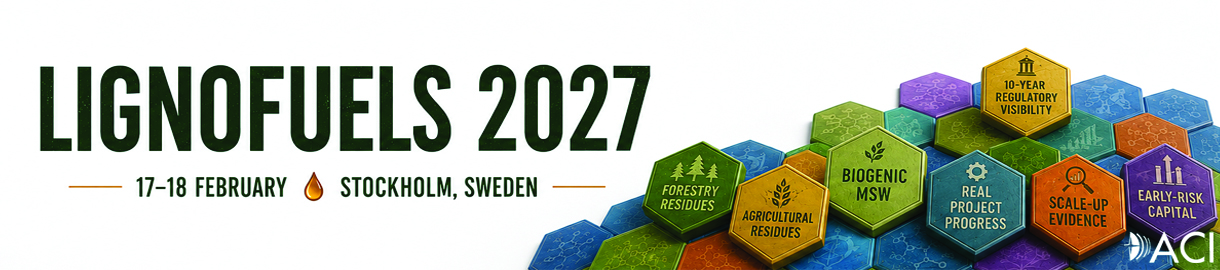
ACI’s Lignofuels 2027, taking place on 17th & 18th February 2027 in Stockholm, Sweden, will examine what is needed to move the next wave of lignofuel projects towards commercial scale.
After years of technology development, demonstration activity and ambitious policy targets, the challenge is increasingly clear: technically credible pathways still need the right combination of feedstock, economics, policy support, risk capital, offtake and execution to become investable projects.
Building of the success of Lignofuels 2026 which brought 100+ senior level executives to Helsinki last February, Lignofuels 2027 moves beyond diagnosing these barriers to examine what must change for projects to proceed. The programme will test whether the sector is genuinely entering a new commercial phase, assess where value and margin can be created across the supply chain, and explore whether regulatory frameworks provide the long-term visibility required for investment.
A major focus will be on mobilising equity and first-of-a-kind risk capital before conventional project finance, alongside building forestry, agricultural residue and biogenic municipal waste supply at investable scale. Technology sessions will focus on operating evidence, quantified improvements and credible scale-up milestones, distinguishing genuine industrial progress from repeated project announcements.
The conference will also stress-test project economics through a dedicated project-scrutiny session, examining capital cost, feedstock risk, technology performance, offtake and market assumptions to identify what would need to change for a project to become investable and reach FID. Dedicated discussions will explore the durable role of lignofuels in road transport, the development of a practical marine market, and the conditions required to strengthen demand and long-term offtake for lignocellulosic SAF.
Bringing together fuel producers, refiners, feedstock suppliers, technology developers, engineering companies, transport fuel buyers, banks, investors, policymakers and research organisations, Lignofuels 2027 connects those developing, financing, supplying, buying and regulating lignofuels. Across two days of evidence-based discussion, problem-solving and senior-level networking, the conference will provide a focused forum to test the evidence behind the next commercial wave, identify the remaining gaps and determine what must happen for more lignofuel projects to move forward at scale.
Book your early bird ticket to Lignofuels 2027 now to join your peers at the unmissable Lignofuels event of the year!
• Rebuilding Confidence in the Next Commercial Wave of Lignofuels: Examine whether current industrial activity represents genuine commercial progress, and what operating, scale-up and capital-commitment evidence is needed to support renewed confidence in the sector.
• Making the Value Chain Work: Profitability, Product Fit and Execution: Explore where margin is created or lost across feedstock, conversion and offtake, and how better product-market matching, operational performance and refinery allocation can strengthen project economics.
• The Ten-Year Regulatory Investment Test: Assess whether current and post-2030 policy frameworks provide the long-term visibility required for investment, including mandates, ETS treatment, feedstock eligibility and HEFA constraints.
• Mobilising Equity and Risk Capital Before Conventional Project Finance: Examine the role of infrastructure funds, strategic investors, project sponsors and other providers of early-risk capital in bridging the gap between development-stage projects and bankable assets.
• Forestry, Agriculture and Biogenic MSW: Building Feedstock Supply at Investable Scale: Compare the real commercial potential of forestry residues, agricultural residues and biogenic municipal waste, including mobilisation, preprocessing, sustainability, logistics and competing uses.
• Project Scrutiny: Reworking the Case for Investment: Stress-test project assumptions around capital cost, feedstock, technology performance, offtake and market positioning to identify what must change before a project can become investable and reach FID.
• Proven Technology Deployment and Scale-Up: Examine which technologies now have credible operating evidence, how earlier scale-up challenges have been addressed and what milestones demonstrate genuine progress towards commercial deployment.
• Technological Breakthroughs to Change Lignofuel Economics: Explore new approaches capable of materially reducing cost, improving yields, strengthening process integration and improving competitiveness against established renewable-fuel pathways.
• Road Transport: Defining the Durable Market for Lignofuels: Assess which road-transport segments are likely to continue requiring liquid fuels, how lignofuels compete with electrification and where renewable diesel and gasoline may retain a long-term commercial role.
• Building a Practical Marine Market for Lignofuels: Examine fuel properties, upgrading requirements, bunkering infrastructure, onboard handling and policy incentives to determine where marine applications can provide realistic routes to early deployment.
• Delivering SAF Offtake: Procurement, Claims and Compliance: Explore when constraints on oils-and-fats feedstocks may create stronger demand for lignocellulosic SAF, and how offtake, certification, book-and-claim, mandates and ETS treatment affect project and buyer decisions.
• Connecting Feedstock, Capital, Technology and Offtake: Consider how the different parts of the value chain can allocate risk, align commercial interests and create the conditions required to move more projects towards commercial scale.
Lignofuels 2027 brings together senior professionals involved in the development, financing, supply, production and use of lignocellulosic fuels across Europe, including:
· Lignofuel Producers and Project Developers: Companies developing, owning and operating lignocellulosic fuel production projects, including advanced biofuels, second-generation ethanol, biocrudes, renewable diesel, marine fuels and lignocellulosic SAF.
· Integrated Energy Companies, Refiners and Fuel Suppliers: Refiners and energy companies developing or integrating lignocellulosic pathways within existing fuel production, upgrading, blending and distribution infrastructure.
· Forestry, Pulp, Paper and Forest-Products Companies: Forest owners and industrial biomass organisations controlling or supplying lignocellulosic resources, including forestry residues, wood-based by-products and other feedstocks relevant to commercial-scale fuel production.
· Feedstock Suppliers, Aggregators and Biomass Logistics Organisations: Companies responsible for sourcing, aggregating, preprocessing, transporting and supplying forestry residues, agricultural residues, biogenic municipal waste and other eligible lignocellulosic feedstocks.
· Aviation, Marine and Road-Fuel Buyers: Airlines, shipping companies, logistics operators, vehicle manufacturers and fuel-procurement teams evaluating where lignofuels can meet long-term transport decarbonisation, compliance and fuel-supply requirements.
· Technology Developers and Process Licensors: Organisations developing conversion, pretreatment, upgrading, gasification, pyrolysis, enzymatic and other lignocellulosic technologies, particularly those progressing from pilot and demonstration scale towards commercial deployment.
· Engineering, Equipment and Plant-Integration Companies: EPC firms, process engineers, equipment manufacturers and industrial solution providers supporting the design, construction, integration, commissioning and operation of commercial lignofuel facilities.
· Banks, Infrastructure Investors and Risk-Capital Providers: Commercial lenders, public finance institutions, infrastructure funds, strategic investors, project sponsors and other capital providers assessing development, first-of-a-kind, scale-up and project-finance risk.
· Policymakers, Regulators and Industry Associations: European and national authorities, sector associations and policy specialists responsible for renewable-fuel mandates, sustainability criteria, feedstock eligibility, transport decarbonisation and the post-2030 regulatory framework.
· Certification, Testing and Sustainability Organisations: Certification bodies, analytical specialists and sustainability experts supporting feedstock verification, greenhouse-gas accounting, traceability and compliance across renewable-fuel value chains.
· Research Institutions and Applied Technology Centres: Universities, research institutes and industrial R&D organisations contributing to technology development, feedstock assessment, process scale-up and commercialisation pathways.
· Senior Decision-Makers Across the Value Chain: Consistent with previous editions, attendees include Chief Executives, Managing Directors, Vice Presidents, Project Directors, Commercial Directors, Investment Directors, Heads of Feedstock, Fuel Procurement, Sustainable Fuels, Technology, Engineering, Sustainability and Business Development responsible for moving projects and commercial strategies forward.
Andy Hill – Managing Director, GAP Alternative Fuels Limited
Robin Post van der Burg – Co-Founder, Torrgas
Henrik Brodin – Head of Energy Transition, Södra
Jérémie Bertrand – Executive Director, Offtake & Feedstock Supply, Elyse Energy
Anders Hultgren – CEO & Founder, Votion Biorefineries
Bharadwaj Kummamuru – Executive Director, World Bioenergy Association
Jonathan Wood – Chief Commercial Officer, Nova Pangaea Technologies
Harri Laurikka – Managing Director, The Bioenergy Association of Finland
Georg Markowz – Senior Technology Expert, CBR Sustainability Partners
Timo Jaakkola – Partner, Taaleri Capital
Anastasia Belinskaya – Business Development & M&A, OMV
Martin Forsén – Executive Chairman, SilviPar
Daniel Madrid García – Trading Director, Generandi
Dan Moloney – President & COO, GIDARA Energy
Taneli Rautio – Senior Business Development Manager, Neste
Domenico Mininni – Policy Director, EBB European Biodiesel Board
Dinis Reis Oliveira – Specialist, Marine Fuels & LCA, Stena Teknik
Stam Achillas – Head of Business Development, 2-Stroke Decarbonisation Solutions, Wärtsilä
Andrew Thomas FRAeS – Director of Sustainability, VistaJet
Monica Johansson – Fuel, Hydrogen Infrastructure & Energy Analyst, Volvo Group

Advanced Biofuels USA advocates for the adoption of advanced biofuels as an energy security, economic development, military flexibility and climate change mitigation solution. Technology neutral and feedstock agnostic, the organization helps clarify details of controversial issues, provides information about job opportunities, helps teachers and students prepare educational materials in science, math and social lessons related to energy security, economic development and environmental sustainability challenges. The website serves a world-wide audience of 32,000 page views/month as a free library of information helping investors, researchers, producers, legislators, opinion-leaders and consumers understand “from seed to wheel” the options they have when it comes to biofuels.
https://advancedbiofuelsusa.info/

ESWET (European Suppliers of Waste-to-Energy Technology) is a European association representing manufacturers in the field of Waste-to-Energy Technology. ESWET’s mission is to raise awareness of the positive implications of Waste-to-Energy technology, such as sustainable waste management, clean and reliable energy, as well as environmental protection. In addition, ESWET fosters the development and dissemination of Waste-to-Energy technology at the European level.
ESWET members’ research and innovation are at the heart of most of Waste-to-Energy plants in Europe and across the world. https://eswet.eu/

The European Biodiesel Board (EBB) is a non-profit organisation established in January 1997. The EBB gathers over 37 members across 21 Member-States, representing over 65% of the European output. Biodiesel is the main European solution to reduce emissions from transport and dependence on imported oil. The EBB promotes the use of biodiesel in the European Union and is committed to fulfil international standards for sustainability in GHG emissions and sustainable feedstock. The EBB is constantly working towards the development of improved and greener technologies.

The Bioenergy Association of Finland (Bioenergia) is the guardian of the interests of more than three hundred member organizations and individual members. As the EU and Finland move towards carbon neutrality, we want to develop the bioenergy sector so that Finland has the best conditions in the world to produce sustainable and even carbon-negative products based on biomass. In our operations, we strive for the highest possible value added and exports, and we support energy self-sufficiency, security of energy supply and supply, employment and the regional economy. We work together with our members as part of a bio- and circular economy where energy is recovered from by-products.
For more information visit us at https://www.bioenergia.fi/
Fecc is a Thought Leadership Platform connecting all parts of the value chain so that distributors of raw materials, ingredients and chemicals can create a sustainable future.
A European federation with a global reach, Fecc is there to listen, be the voice for, inform and serve our industry and its stakeholders.

Worldoils is a company that combines the power of marketing as well as thein-house expertise for the Oil, Gas, Offshore and the Maritime industries. Worldoils’ web portal www.worldoils.com has become a truly central platform for visitors who need information regarding oil and gas products and services, research, training, conferences, news and events as well as a popular advertising base for providers of Oil, Gas, Marine and Offshore services. Worldoils has also launched the jobs system and a marketplace. In the recent months, Worldoils has strengthened its position as a fast developing central place for buying and selling of land rigs, offshore rigs, barge rigs and other oilfield and subsea equipment.

The German Bioethanol Industry Association (BDBe) advocates for reducing greenhouse gas emissions in the transport sector through the use of bioethanol.
With a holistic approach, the BDBe covers the entire production chain, from field to fuel. The BDBe coordinates the political advocacy efforts of the German bioethanol industry and communicates its findings to policymakers, businesses, scientists, the media, and the public.

F&L Asia Ltd stands at the forefront of innovation and thought leadership in the global fuels and lubricants industry. As a pioneering publishing and events company, we have established ourselves as a beacon of progress and a hub of innovation not only in our region but across the globe. Our dedication to fostering connections, facilitating groundbreaking discussions, and highlighting the latest advancements in the fuels and lubricants industry drives the sector forward, setting new benchmarks for excellence. With a rich legacy of curating influential content and orchestrating seminal events, F&L Asia Ltd transcends being merely a platform; we are a catalyst for progress, innovation, and collaboration among industry professionals worldwide. Our commitment to excellence and our passion for knowledge dissemination position us as the quintessential resource for industry insights, trends, and networking opportunities, making F&L Asia Ltd. the go-to partner for those looking to shape the future of the fuels and lubricants industry.
Bioenergy Europe is the voice of European bioenergy. It aims to develop a sustainable bioenergy market based on fair business conditions. Founded in 1990, Bioenergy Europe is a non-profit, Brussels-based international organisation bringing together associations, companies, academia and research institutes from across Europe.
Bioenergy Europe is the umbrella organisation of the European Pellet Council (EPC). The EPC is an essential part of Bioenergy Europe’s internal organisation, bringing together bioenergy experts and company representatives from all over Europe.

Biomass events promotion resource is the international events bulletin focusing on biomass news, biomass technologies, biomass conferences and exhibitions.
The website has been established to supply information about the latest events in biomass and bioenergy field. Our main objective is to support biomass industries worldwide, promoting key biomass events. We believe that biomass will play one of the decisive roles in creative sustainable bioenergy Europe.

Axens group provides a complete range of solutions for the conversion of oil and biomass to cleaner fuels, the production and purification of major petrochemical intermediates, the chemical recycling of plastics, all natural gas treatment and conversion options along with water treatment and carbon capture.
The offer includes technologies, equipment, furnaces, modular units, catalysts, adsorbents and related services. Axens is ideally positioned to cover the entire value chain, from feasibility study to unit start-up and follow-up throughout the entire unit life cycle.
This unique position ensures the highest level of performance with a reduced environmental footprint. Axens global offer is based on highly trained human resources, modern production facilities and an extended global network for industrial, technical supports and commercial services. Axens is an IFP Group company.

Valmet is a leading global developer and supplier of process technologies, automation and services for the pulp, paper and energy industries. With our automation systems and flow control solutions we serve an even wider base of process industries. Our more than 19,000 professionals around the world work close to our customers and are committed to moving our customers’ performance forward – every day.
We use our expertise to provide and develop sustainable, cost-effective technologies and solutions for companies in the biofuels and biomaterials industry. These include flow control solutions and automation, as well as systems for entire process areas, like CHP boilers and hydrolysis systems. And we have over 220 years of industrial history and a strong track record in continuous improvement and renewal.
Find out how we can move your performance forward with our unique technology, automation, and services offering for the biomass industry at www.valmet.com.
ACI has put together a range of packages to suit your requirements. These range from branding options, to full scale partner solutions and can be tailored to meet your objectives and budgets.
If you are launching a new product or service and wish to gain visibility and brand recognition within your industry, contact us today!
For commercial opportunities, please contact:
Sam Cormack
Tel: +44 20 3141 0609
Email: [email protected]
Event Overview
Lignofuels 2026 brought together 96 attendees from 69 companies across the lignocellulosic fuels value chain. Over two days of presentations, panel discussions and networking in Helsinki, industry leaders examined how demand, policy, feedstock availability, technology scale-up and finance are shaping the next phase of commercial lignofuel development.
A Cross-Industry Lignofuels Forum
The event welcomed fuel producers, project developers, technology companies, engineering firms, refiners, feedstock organisations, financial institutions, research bodies and transport-sector end users. Participants included organisations such as Neste, VTT, Fintoil, Valmet, Axens, Chempolis, Reolum, DHL, VistaJet, Stena Rederi, Shell, Repsol and SkyNRG, reflecting the broad range of organisations involved in bringing lignocellulosic fuels towards commercial deployment.
Market Outlook and Future Demand
The conference opened with an assessment of the market outlook for lignofuels and advanced biofuels. Discussions examined growing demand for renewable fuels across road transport, aviation and maritime shipping, alongside the continuing role of liquid fuels in sectors where electrification alone is unlikely to provide a complete decarbonisation solution. Sustainable aviation fuel emerged as a particularly important demand driver, with speakers examining how future mandates and market growth could influence lignocellulosic fuel deployment.
Policy, Regulation and Investment Signals
Policy remained central throughout the programme. Speakers examined the Renewable Energy Directive, ReFuelEU Aviation, FuelEU Maritime and wider European climate policy, with particular attention given to uncertainty beyond 2030. Discussions highlighted the importance of long-term regulatory visibility, feedstock eligibility rules, sustainability requirements and compliance frameworks in giving developers and investors sufficient confidence to commit capital to large-scale projects.

Feedstocks, Biomass and Supply Chains
Feedstock availability was one of the most prominent themes of the event. Sessions explored the role of forestry residues, agricultural residues, wood waste and other lignocellulosic resources in meeting future renewable-fuel demand. Speakers also examined the practical challenges of biomass mobilisation, logistics, sustainable sourcing and competing uses, emphasising that theoretical resource availability must ultimately translate into reliable, cost-effective supply chains capable of supporting commercial plants.
Technology Commercialisation and Scale-Up
Technical sessions examined the progress of cellulosic ethanol, biomass-to-liquid fuels, alcohol-to-jet pathways, pyrolysis, gasification and integrated biomass-hydrogen systems. Presentations covered pilot projects, demonstration facilities and emerging commercial plants, while highlighting the continuing challenge of moving proven technologies into reliable operation at much larger scale. Integrated biorefineries, co-product strategies, digitalisation and process optimisation were also explored as potential ways of improving project economics and reducing scale-up risk.
Financing, Bankability and Project Delivery
A major part of the programme focused on what is required to make lignofuel projects financeable. Banks, public funding institutions, investors and developers discussed the importance of secure feedstock, proven technology, experienced project teams, long-term customer commitments and effective risk allocation. The event also examined final investment decision readiness and the gap between technically credible projects and projects developed sufficiently far to satisfy lenders and investors.
Moving from Technology Promise to Commercial Execution
Across the conference, a consistent message emerged: the industry is increasingly moving beyond the question of whether lignofuel technologies can work and towards the more difficult challenge of delivering projects commercially. Future progress will depend on aligning sustainable feedstock supply, technology performance, policy support, financing, offtake and industrial execution. Lignofuels 2026 therefore provided a forum for the sector to assess where commercialisation is progressing, where barriers remain and what will be required to convert technological potential into reliable production at scale.